
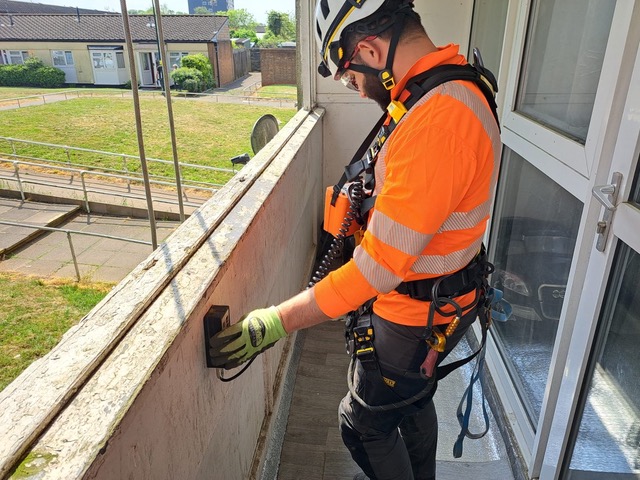
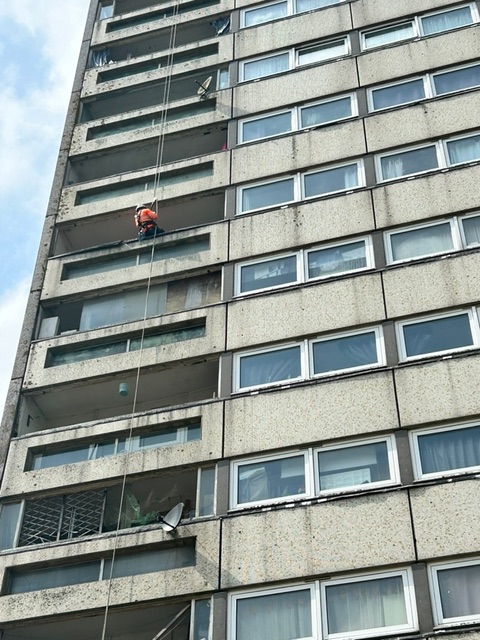
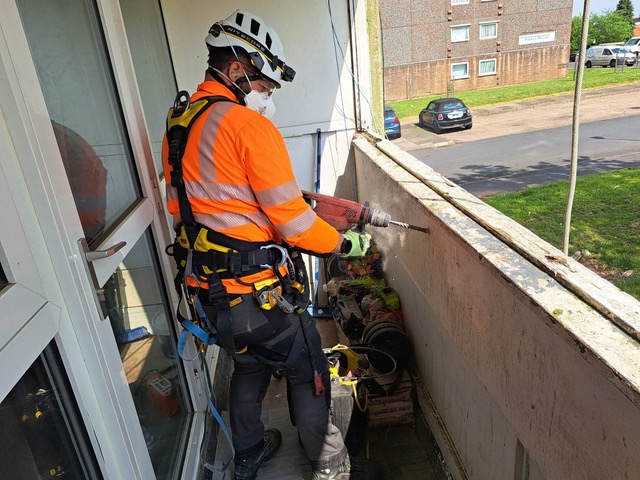
We have recently carried out a Defect Survey to a High-Rise Tower Block in Birmingham. Our Rope Access Surveyors reported high levels of spalling material on the inner wall of a balcony, this was interesting due to the fact the inner side is protected from the elements. We reported this to our client and we were tasked to return to undertake Chloride sampling and Carbonation Tests to a number of balconies.
Concrete Carbonation

This is a process where carbon dioxide reacts with alkaline materials in the concrete and creates calcium carbonate, the most common loss of alkalinity in concrete. It is important for a high level of alkalinity in concrete to prevent corrosion of the steel reinforcement.
We offer Concrete Carbonation Testing as part of our broader building surveys and investigations services
We primarily deliver this type of testing to difficult to reach areas, such as High-Rise Buildings or Bridges, access is obtained using Rope Access methods.
This test is crucial for evaluating the durability of concrete structures. During the testing process we use a phenolphthalein indicator solution, which turns pink in contact with alkaline (uncarbonated) concrete and remains colourless in carbonated concrete. The Carbonated areas are measured and recorded.
We specialise in testing to reinforced concrete structures such as High-Rise Buildings and Bridges using Rope Access methods.
We have been delivering Chloride Sampling and Carbonation Testing to Concrete using Rope Access methods for many years, this is a very cost effective and unobtrusive method of gaining access to an affected area without the requirement of scaffolding of hired machinery.